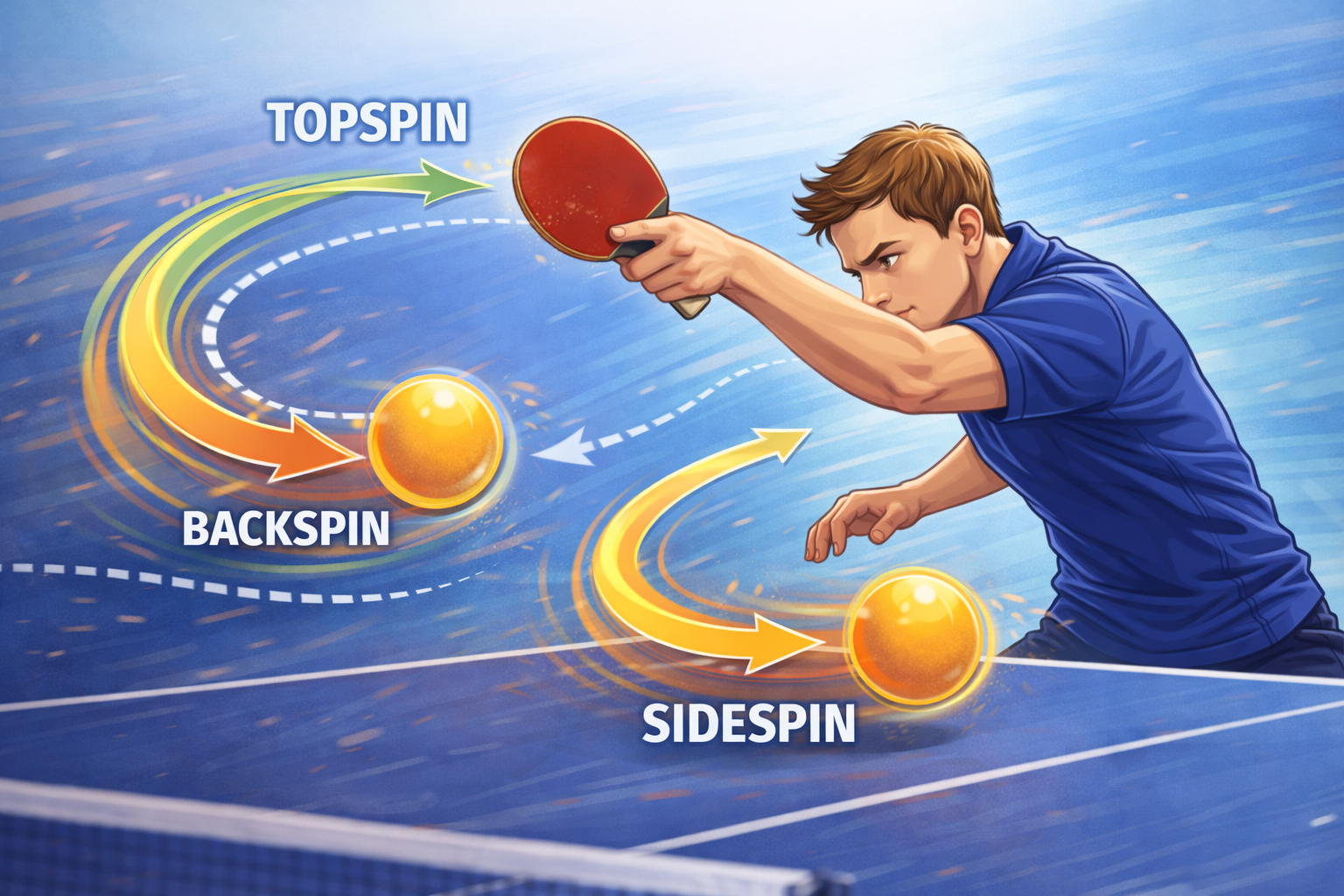
Understanding spin is crucial in table tennis for anticipating the ball’s trajectory and improving the quality of your returns. Spin affects the ball’s bounce, speed, and direction—reading it early can give you a competitive edge. This guide covers visual cues, racket feel, and common types of spin encountered in table tennis, designed for players from beginners to advanced wanting to sharpen their spin reading skills.
Fundamentals of Spin in Table Tennis
What Is Spin and Why It Matters
Spin in table tennis refers to the rotation of the ball around its axis during flight. Different spins influence how the ball reacts upon contact with the table or your racket, affecting its speed, bounce, and trajectory. Accurately reading these spins helps you adapt your stroke timing and angle, reducing unforced errors and allowing more tactical shot placement.
Types of Spin: Topspin, Backspin, Sidespin, and No-spin
- Topspin: The ball rotates forward. It tends to dip faster and bounce higher, accelerating after the bounce. Topspin can force you to strike earlier and with a closed racket angle.
- Backspin: The ball rotates backward. It floats more slowly and bounces lower and shorter, often requiring you to lift the ball with a more open racket face.
- Sidespin: The ball spins sideways, curving left or right in flight and on bounce, affecting placement and making control challenging.
- No-spin serve: Also known as float serve, the ball has minimal rotation and tends to have unpredictable bounce, demanding careful judgement and soft touch for return.
How Spin Influences Ball Behavior
Spin impacts the ball’s trajectory — topspin causes the ball to jump downward more sharply, backspin slows it and keeps it low, while sidespin curves its horizontal path. On bounce, spin influences speed and direction, forcing you to adjust racket angle and stroke timing. Recognizing spin early is key to preparing your return and footwork optimally.
Visual Cues to Identify Spin
Recognizing Spin from the Opponent’s Racket Movement
Watch the opponent’s racket closely during contact. A brush-up motion usually indicates topspin; brushing down suggests backspin; and lateral or wrist flicks hint at sidespin. The speed and angle of the racket strike help predict the spin type and intensity.
Observing Ball Trajectory and Bounce Characteristics
Topspin balls descend quickly with a sharp bounce upward, while backspin balls float slower and bounce low or even back toward the net. Sidespin causes lateral deviation mid-flight and on bounce, visible from the ball’s curved path. A no-spin serve shows a straighter or wobbling trajectory with an inconsistent bounce.
Spotting the Throw Angle and Wrist Position During Serve
During serve, the throw angle and wrist position offer telling clues. A pronated wrist and upward throw angle often produce topspin; a downward flick and flatter throw create backspin. Sidespin usually involves a wrist twist or sidewards flick combined with angled ball toss. Developing awareness of these cues improves serve receive anticipation significantly.
Using Racket Contact and Feel to Read Spin
How to Sense Spin on Incoming Ball Through Racket Dwell Time
Pay attention to the racket dwell time, the moment the ball stays on your racket’s surface. A longer dwell time often corresponds with greater spin interaction, helping you sense the spin type through tactile feedback. Adjust your racket angle during contact accordingly to counter or leverage the spin.
Adjusting Racket Angle for Different Spin Types
- For topspin, close your racket face slightly to brush the ball downward.
- For backspin, open your racket angle and lift the ball gently.
- Against sidespin, adjust your racket angle left or right to counter curved ball flight.
- For no-spin or float balls, maintain a neutral racket angle and focus on placement.
The Role of Rubber Type and Blade in Spin Sensitivity
The rubber’s tackiness affects how much spin you can feel when contacting the ball. Tensor rubber, with its high elasticity and enhanced grippiness, increases sensitivity to spin changes, aiding in reading and responding effectively. Blade composition—such as wood layers and carbon inclusions—influences how vibration and ball dwell time transmit to your hand, further sharpening spin perception.
Common Spin Patterns in Serves and Returns
Typical Spin Combos in Short Game and Serve Receive
Short game often combines backspin with subtle sidespin to force weak returns, while serve receive focuses on identifying varied spins like reverse pendulum and tomahawk styles. Players commonly mix spins to create deceptive patterns that test your reading skills and footwork agility.
Decoding Opponent’s Serve Spin: Tips and Drills
- Practice slow-motion observation of racket and ball toss cues.
- Use partner drills where servers alternate spin types randomly to challenge your reading ability.
- Record and review serves to analyze spin variations visually.
How to Counter and Adapt Your Return Based on Spin Readings
Once you identify the spin, tailor your stroke accordingly—open racket for backspin lifts, closed racket for topspin, and directional adjustment for sidespin returns. Combining spin reading with effective footwork enhances your positioning and stroke precision.
Training Techniques to Improve Spin Reading
Drills for Developing Visual Recognition of Spin
- Shadow practice focusing on racket angle and ball toss during serve simulations.
- Slow-motion training with video playback for detailed spin observation.
- Partner drill sessions emphasizing varied spins and immediate feedback.
Partner Exercises Focusing on Spin Variation and Response
Organize rallies where the partner intentionally generates topspin, backspin, and sidespin shots, requiring you to adjust returns dynamically. This encourages active reading and quick adaptation under real conditions.
Using Video Analysis for Spin Study
Record matches or practice sessions to study opponents’ spin techniques and your own return approach. Focus on wrist position, racket brushing angle, and ball trajectory to deepen your understanding of spin effects and recognition.
Tactical Advantages of Reading Spin Correctly
Planning Attacks and Defensive Plays Based on Spin
Reading spin enables better tactical choices, such as attacking with aggressive loops against predictable backspin returns or defending well-rounded with controlled blocks against heavy topspin. Understanding spin nuances supports setting up winning combinations and counter-attack sequences.
Reducing Unforced Errors by Anticipating Spin
Early spin recognition lets you prepare your racket angle and stroke force, reducing mishits caused by unexpected ball behavior. This boosts consistency and lowers costly unforced errors, improving match endurance and confidence.
Incorporating Spin Reading into Footwork and Positioning
Combine spin cues with advance footwork to get into optimal striking zones. Adjust your distance and lateral movement based on the anticipated spin-induced ball bounce and trajectory. This synergy sharpens your overall defensive and offensive effectiveness.
Common Mistakes When Trying to Read Spin
Misreading Spin Due to Poor Observation or Timing
Rushing your reading or focusing too late on ball contact leads to mistaken spin interpretation, causing improper stroke adjustments. Developing patience and early visual scanning of the opponent’s racket and ball path mitigates this.
Overcompensating and Losing Stroke Precision
Adjusting racket angle excessively in fear of spin can reduce control and accuracy. Balance your response by trusting tactile feedback and making measured adjustments.
Ignoring Opponent’s Variations and Deceptions
Many players use spin disguises, such as no-spin serves or mixed spins, to confuse opponents. Ignoring opponent variability and relying on fixed reading patterns makes you vulnerable. Stay alert to subtle cues and practice adaptability.
Conclusion
Reading spin effectively in table tennis requires focused observation and practice of both visual and tactile cues. Early recognition enables preparation of your stroke and position, enhancing consistency and control. Integrate spin reading drills into your training routine to develop instinctive responses under match conditions. Mastering spin interpretation adds a critical tactical layer to your game and provides a significant competitive edge.