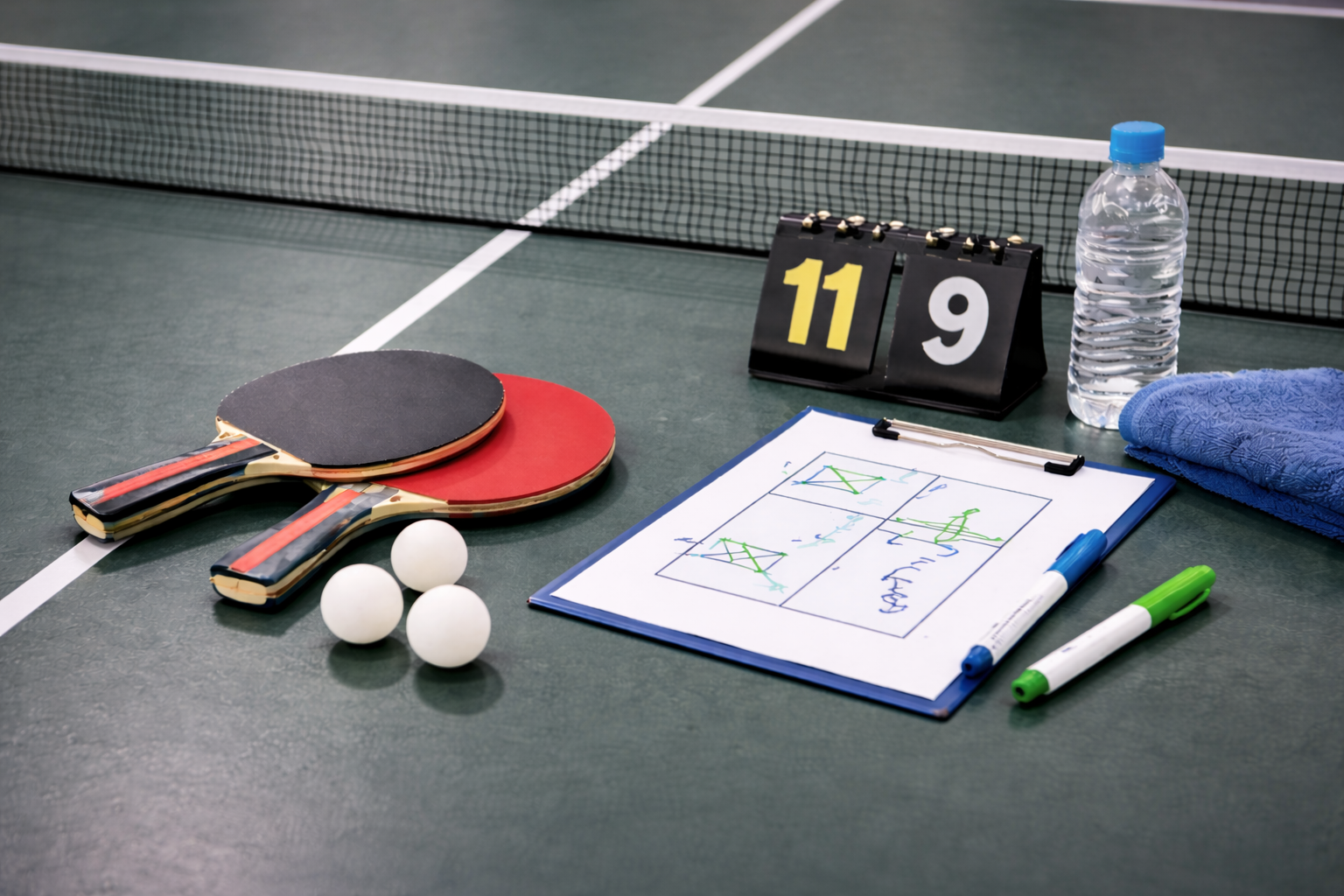
Overview of Table Tennis Equipment and Setup
Official table and net dimensions
The official table tennis table size, as specified by the International Table Tennis Federation (ITTF), measures 2.74 meters in length, 1.525 meters in width, and stands 0.76 meters high from the ground to the playing surface. The net should be 15.25 centimeters high and extend 15.25 centimeters beyond each side of the table. Having regulation-compliant equipment ensures that beginners get accustomed to consistent and fair play conditions from the start.
Types of rackets and balls used
Rackets for beginners typically feature a blade composed of 5 to 7 layers of wood, sometimes with composite layers for added control and feel. The rubber on the racket, often inverted for better spin potential, combined with sponge layers of moderate hardness, influences ball control and spin generation, which are critical aspects at the beginner level. For more details on racket maintenance, see How Often Should You Change Table Tennis Rubbers for Peak Performance?
Table tennis balls used in official play are 40mm in diameter, weighing approximately 2.7 grams, made from plastic materials conforming to ITTF standards to maintain consistent bounce and flight.
Importance of blade composition and rubber type for beginners
For beginners, a racket with balanced blade composition emphasizing control over speed aids in developing fundamental stroke techniques like the topspin and backhand loop. Moderate sponge hardness increases dwell time on the racket surface, facilitating easier spin creation and better ball placement. Rubber types such as tensor rubber can enhance spin sensitivity, but beginners should prioritize grip comfort and racket feel to build confident strokes without overwhelming complexity.
Basic Rules of Play
Starting the game and deciding serve/receive
Beginners start play by deciding who serves first; this can be done through a coin toss or racket spin. The initial server serves for two points, after which the receiver serves for the next two, alternating until the game concludes or reaches deuce. This structure encourages fairness and practice of both serve and receive techniques.
Gameplay flow: sequence of rallies
A rally begins with a legal serve, followed by players alternately striking the ball across the net. Each ball must bounce once on the opponent’s side, and the rally continues until a player fails to execute a correct return. Understanding this basic sequence helps beginners grasp flow and anticipate their turn during play.
Key terminology: rally, let, point
Rally: The back-and-forth exchange of shots between players starting from a serve until a point is won.
Let: A rally or serve that is stopped and replayed without awarding points, commonly due to interference like the ball touching the net on a serve but landing properly. For a deeper understanding, check Table Tennis Let Rule Explained: When and How Lets Affect Your Game.
Point: Scored when the opponent fails to return the ball properly, commits a fault, or violates other rules.
Scoring System Explained
Points per rally and game-winning criteria
Points are awarded on every rally, with the winner earning one point. Games are played to 11 points, but a player must win by a margin of at least 2 points. If the score reaches 10-10, play continues until that 2-point lead is obtained, often referred to as the deuce phase.
Match formats for beginners (best of 3 or 5 games)
Beginners often play matches structured as best of 3 or 5 games, meaning the first player to win 2 or 3 games respectively wins the match. This format balances playtime and endurance appropriate for learning and competitive experience.
Role of deuce and advantage
At deuce (10-10), service alternates every point rather than every two, increasing pressure and requiring strategic focus. The player who wins the next point gains an advantage but must win the following point to close the game. If the opponent scores, the score returns to deuce, continuing until a 2-point lead is established.
Serving Rules for Beginners
Legal serve: ball toss, impact point, and visibility
A legal serve begins with the ball resting on the open palm of the free hand, tossed vertically at least 16 cm without spin. The server must strike the ball behind the end line and above the table surface. Importantly, the ball must be visible to the opponent throughout the serve. These rules ensure fairness and reduce deceptive serve techniques, promoting effective serve learning for beginners. For detailed serve rules, see Comprehensive Guide to the Rules for Table Tennis Serve.
Serving sequences including doubles considerations
In singles, the serve switches every two points between players. In doubles, serves follow a strict rotation sequence among all four players, with serves required to land diagonally in the opponent’s service box. Serving order and positioning differ from singles and players should practice these to avoid faults and ensure smooth play.
Common service faults and how to avoid them
- Missing the minimum toss height.
- Hiding the ball during the toss or strike.
- Striking the ball outside the legal contact zone.
- Serving before the receiver is ready.
Practicing in front of a mirror and recording serves can help beginners correct these faults and improve legal service delivery.
Return of Serve and Rally Play
Correct ball contact and stroke type for service return
When returning a serve, the ball must be struck after it bounces once on the receiver’s side, contacting the ball cleanly without double hits. Beginners typically use push strokes or gentle loops initially, focusing on timing and correct racket angle to handle various spins. To improve your backhand technique, refer to Table Tennis Backhand Topspin Tutorial: Master the Essential Technique.
Rules governing topspin and backhand loop during rallies
Topspin loops and backhand loops are effective rally strokes where the ball is brushed imparting forward rotation. Stroke rules emphasize clean contact and alternating strokes during doubles play. Beginners should focus on mastering proper racket angle and coordinating footwork to execute these strokes effectively.
Definition and importance of dwell time during play
Dwell time is the moment the ball remains in contact with the racket. Increasing dwell time improves spin generation and stroke control. For beginners, awareness of dwell time helps develop consistent and controlled shots, crucial for effective topspin and loop techniques.
Faults and Let Calls
Typical faults beginners should watch for
- Double hitting or missing the ball.
- Ball bouncing twice on the player’s side before return.
- Serving faults like illegal toss or concealment.
- Foot faults, such as stepping over the end line during serve.
What constitutes a let and when it is called
A let can be called when the serve touches the net but lands legally, or if play is interrupted by external factors like ball from another table or unexpected distractions. The point is replayed with no score change.
Handling net service faults and irregular bounces
If the served ball hits the net and does not land correctly, it is a fault and the opponent scores a point. Irregular bounces such as balls hitting edges or severe distractions may result in lets to maintain fairness.
Doubles Play Rules for Beginners
Difference from singles: serving sequence and rotation
Doubles require strict serving rotation among four players, each serving for two points in order. Serves must be delivered diagonally, bouncing once on the server’s side and once on the receiver’s designated half. Opponents must adapt to serve and receive positioning unique to doubles.
Positioning and hitting order
During rallies, doubles partners must alternate hitting the ball; one player cannot strike twice consecutively. Correct positioning on designated halves at serve initiation is mandatory, although players may move freely once play starts.
Communication tips for beginners in doubles
Effective doubles play relies on clear communication about serving order, shot coverage, and positioning to avoid faults. Beginners should practice hand signals or verbal cues during play to coordinate effectively with partners.
Sportsmanship and Conduct According to ITTF Guidelines
Basic etiquette on and off the table
Respectful behavior includes shaking hands before and after matches, avoiding disruptive comments, and adhering to umpire decisions. Maintaining composure and encouraging opponents improve the playing environment for everyone.
Respecting opponents and referees
Players must acknowledge calls made by umpires without argument and show appreciation for good rallies. Fair play fosters sportsmanship and contributes to personal growth as a player.
Common beginner mistakes to avoid
- Disputing calls excessively.
- Showing frustration or disrespect towards opponents or officials.
- Ignoring rule basics such as proper serve technique or foot faults.
Adhering to ITTF conduct standards enhances both match quality and player reputation.
Conclusion
- Mastering table tennis rules for beginners is essential for consistent and fair play, helping players enjoy and improve their game.
- Regular practice of serving and receiving within official guidelines fosters good habits early on.
- Understanding faults, lets, and doubles dynamics prevents unnecessary point losses and confusion.
- Following sportsmanship principles promotes positive competition and personal development in the sport.