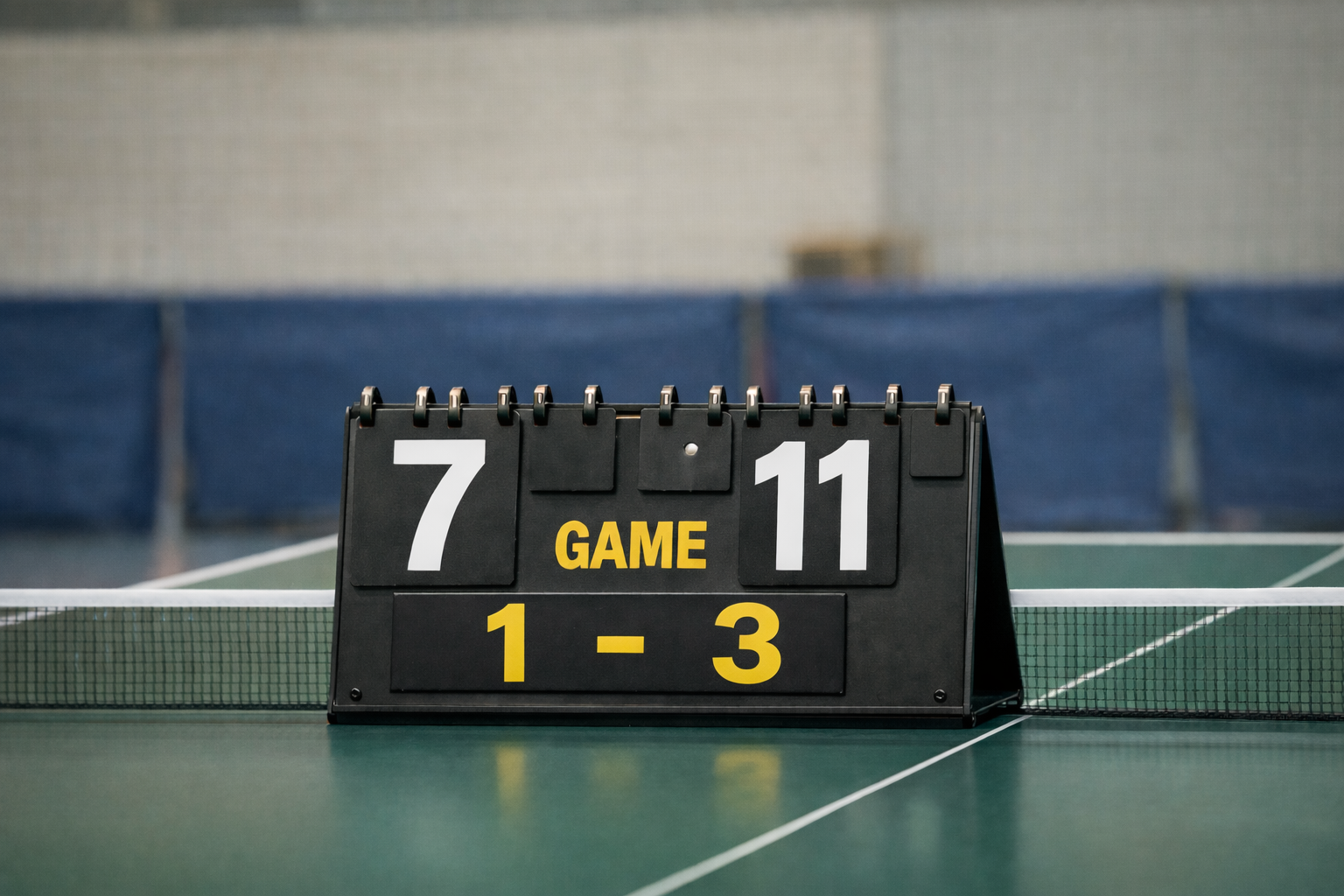
Table tennis scoring rules form the backbone of competitive play and strategy. Knowing how points are scored and games are structured is essential for players and enthusiasts. This guide explains scoring terminology and procedures used in official matches governed by the International Table Tennis Federation (ITTF). Whether you’re a beginner or advanced player, mastering scoring rules will improve your tactical understanding.
Basic Point Scoring in Table Tennis
When a point is awarded
A point in table tennis is awarded to a player when their opponent fails to make a correct return. This can occur due to several reasons: the ball bounces twice on the opponent’s side; the opponent fails to return the ball before it bounces twice; the opponent’s return misses the table; or the opponent commits a service fault. The International Table Tennis Federation stipulates that each rally’s winner scores one point.
Common ways to win a point—service faults, returns, nets
- Service faults: Failing to execute a legal serve, such as not tossing the ball at least 16 cm vertically or hiding the ball from the opponent.
- Return errors: Missing the table on return, striking the ball twice, or hitting the ball before it bounces on your side.
- Net faults: If the ball does not clear the net or touches the net but does not land on the opponent’s side, it results in a point for the opponent unless it is a let serve.
Examples of point-winning scenarios
- A return shot that flies wide or long beyond the opponent’s end line.
- A player fails to return a serve due to deceptive spin.
- Opponent commits a service fault by hiding the ball during the serve.
Game Format and Winning a Game
Standard point target per game (usually 11 points)
Official table tennis games are played to 11 points. The first player to reach 11 points, provided they lead by at least a 2-point margin, wins the game. This scoring system places emphasis on faster, dynamic rallies.
The concept of winning by a 2-point margin
If the score reaches 10-10, a player must then win by a 2-point margin. This means play continues indefinitely until one player leads by two points, making deuce situations both tense and strategic.
What happens during deuce and advantage scoring
At deuce (10-10), serves alternate every point instead of every two points, increasing pressure and changing the rhythm. A player who wins the next point gains the advantage but must still secure the subsequent point to win the game. If the opponent scores, the score returns to deuce, continuing this cycle.
Match Structure
Number of games in a standard match (best of 5 or 7)
Matches consist of multiple games, commonly played as best of 5 or best of 7 games. In a best-of-5 format, the first player to win 3 games wins the match; in best-of-7, the first to 4 games wins.
How matches are decided based on game wins
The player who wins the majority of prescribed games (3 in best of 5, 4 in best of 7) wins the match. This structure balances endurance with skill, ensuring consistent performance over several games.
Strategies related to match scoring structure
Players often adopt pacing strategies—managing energy and mental focus based on the match length. Early games may focus on safe play to avoid errors, while later games might involve more aggressive tactics to secure the match. Understanding the scoring momentum can psychologically pressure opponents.
Service Rotation and Rules
Service changes every 2 points under normal play
Under ITTF rules, the service changes every 2 points during a game. The player serving delivers two consecutive serves, after which the opponent serves for two points, alternating until the game ends or until deuce is reached.
Service rotation during deuce
When the score reaches deuce (10-10), the service alternates after every single point, increasing unpredictability and requiring players to adjust serve tactics rapidly.
How serve receive affects scoring and strategy
The receiver’s positioning and anticipation can influence rally outcomes. Effective serve receive allows a player to neutralize spin or placement advantages, turning defense quickly into offense. Skilled players vary their serve receive tactics depending on the score and opponent tendencies. For detailed techniques, see how to return heavy spin serve.
Scoring Irregularities and Penalties
Scenarios causing point deductions or penalties
Points may be awarded to the opponent if a player commits rule violations such as illegal serves, unsportsmanlike conduct, or deliberate time-wasting. Repeated infractions can incur penalties that impact scoring or lead to disqualification.
Let serves and when points are replayed
A let serve occurs when the ball touches the net assembly during service but still lands correctly on the opponent’s side. In this case, the point is replayed with no score change, ensuring fairness without penalizing the server for net interference.
Rule violations impacting score
Common violations include serving out of turn, incorrect service position, or hitting the ball twice in a row. Such faults result in the opponent being awarded a point immediately.
Differences in Scoring for Doubles Matches
Alternate service pattern and rotation in doubles
In doubles, service rotation is more complex. The serve passes between the four players in a fixed sequence every 2 points, rotating among pairs and individual partners. This ensures every player serves and receives in a predetermined order to maintain fairness. For more details, see the comprehensive guide to table tennis doubles rules.
Specific rules for team point scoring
Each point won counts towards the serving pair’s score. Additionally, partners must alternate shots during a rally, meaning a player cannot strike the ball twice consecutively, which differs from singles play and influences point dynamics.
Court positioning influence on scoring
Doubles players must serve diagonally from the server’s right half to the receiver’s right half. Proper positioning affects the legality of serves and receiving, with scoring consequences if violated.
Impact of Scoring Rules on Match Tactics
Using scoring awareness to pressure opponents
Players often use score situations—such as approaching game or match points—to increase aggression or alter tactics. Psychological pressure can induce errors or force defensive play from opponents.
Adjusting serves and rally style based on score
Strategic choices change with score; for example, players may use higher spin or deceptive serves when ahead to close out games or play conservatively at critical deuce points to avoid faults. Rally length and shot selection may also adapt based on scoring context.
Psychological factors around scoring and momentum
Momentum swings tied to scoring greatly influence mental state and performance. Players who understand the ebb and flow of scoring can capitalize on opponent nervousness or fatigue at key junctures.